

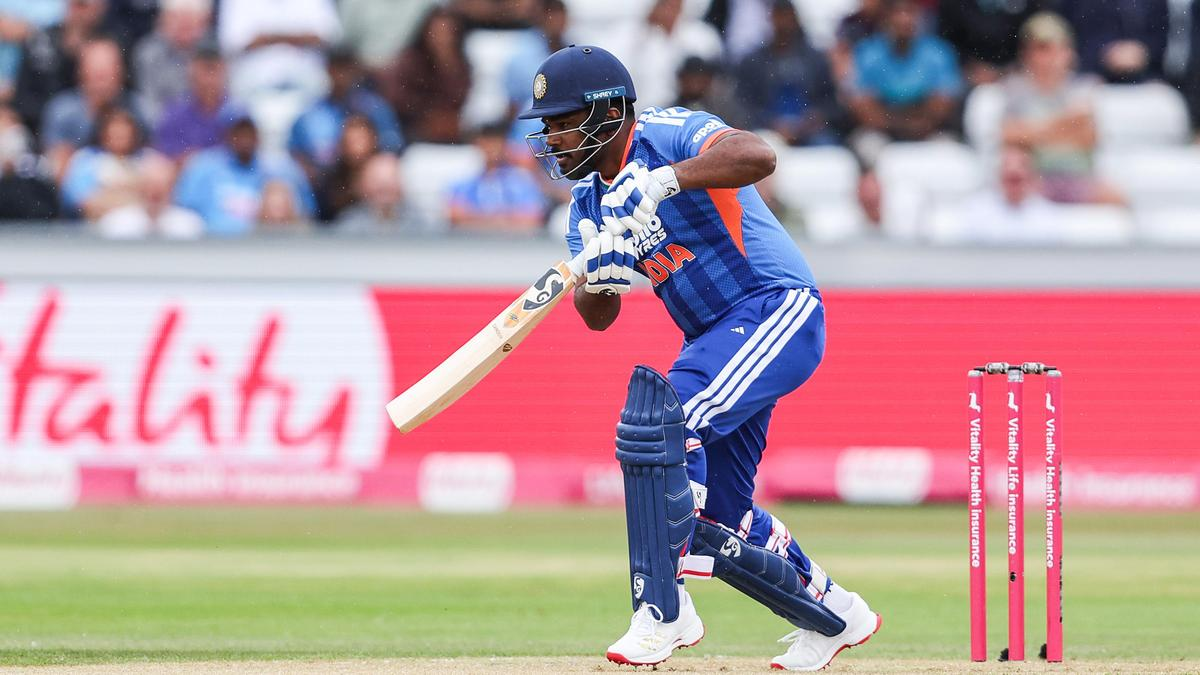
The omission of Sanju Samson from India’s T20I squad for the upcoming Zimbabwe series has become one of the most debated selection decisions in Indian cricket. The wicketkeeper-batter, who has often been praised for his elegant stroke play and explosive batting, has once again found himself on the outside looking in. While the decision disappointed many fans and cricket experts, it also reflects the selectors’ broader strategy of building squad depth and testing emerging talent.
Although the Board of Control for Cricket in India (BCCI) has not explicitly labeled Samson’s exclusion as a permanent setback, several factors appear to have influenced the decision.
Recent Dip in Form
One of the biggest reasons behind Sanju Samson omission is his recent lack of consistency. Despite being regarded as one of India’s most naturally gifted batters, Samson has struggled to convert promising starts into match-winning performances in recent outings.
Selectors often prioritize players who consistently deliver under pressure, especially in the shortest format where every innings carries significant value. Reports suggest that Samson’s recent performances did not meet the expectations of the selection committee, prompting them to explore other options for the Zimbabwe series.
Consistency has long been Samson’s biggest challenge. Throughout his international career, he has produced breathtaking knocks but has also endured prolonged periods of low scores. This inconsistency has repeatedly placed him in a difficult position whenever India has a surplus of batting talent.
Opportunity for Young Players
Another major reason for Samson’s omission is India’s focus on developing its next generation of cricketers.
The Zimbabwe tour presents an ideal opportunity to test young players in international conditions without risking India’s core squad. Reports indicate that the selectors wanted to provide greater exposure to rising stars, including young wicketkeeping and batting options, rather than sticking with established names.
India’s cricket pipeline is stronger than ever. Every IPL season produces several players capable of competing at the international level, making competition for places incredibly intense. The Zimbabwe series allows the management to assess how these emerging players perform against international opposition before bigger tournaments.
Intense Competition for Wicketkeeper’s Spot
The wicketkeeper-batter position has become one of the most competitive roles in Indian cricket.
Apart from Sanju Samson, India currently has several capable wicketkeeping options, including experienced players and younger talents making rapid progress. The selectors have increasingly rotated players to evaluate different combinations rather than relying on a single backup keeper.
With multiple wicketkeepers offering aggressive batting styles and flexibility in the batting order, Samson’s place was never guaranteed despite his experience.
Competition has always been fierce in Indian cricket, and even established international players occasionally miss out when selectors choose to experiment with different combinations.
Squad Rotation and Bench Strength
Modern international cricket involves an extremely demanding calendar. Teams now regularly rotate players to manage workloads while simultaneously building a larger pool of international-ready cricketers.
According to reports, the selectors have maintained that Samson’s exclusion should not necessarily be viewed as a demotion but rather as part of a broader plan to test India’s bench strength ahead of future tournaments.
This strategy has become increasingly common across international cricket. Rather than relying solely on a fixed playing XI, successful teams develop multiple players for every position so they remain competitive despite injuries or workload management.
Looking Beyond Immediate Results
The Zimbabwe series is not merely about winning matches. It is also about preparing India’s squad for the future.
With major ICC tournaments always on the horizon, selectors are constantly evaluating players who could become long-term assets. Giving opportunities to newcomers during bilateral series helps management understand which players can handle international pressure.
From this perspective, Samson’s omission appears to be part of a long-term planning process rather than a judgment on his overall ability.
Mixed Reactions from Cricket Experts
Samson’s exclusion has generated considerable debate among former cricketers and analysts.
Several experts have questioned whether the decision was too harsh, particularly given Samson’s contributions in previous international assignments. Some have argued that a few poor performances should not outweigh the impact of a player who has repeatedly demonstrated his match-winning ability.
Former India spinner Ravichandran Ashwin was among those who publicly questioned the decision, suggesting that Samson’s omission appeared unfair and could send the wrong message to players competing for places.
Others, however, believe the selectors are justified in rewarding younger players who have consistently impressed in domestic cricket and the IPL.
The Challenge of Consistency
Throughout his career, Sanju Samson has faced the same criticism—his inability to consistently capitalize on his immense talent.
Few Indian batters possess Samson’s range of stroke-making. On his day, he can dominate even the world’s best bowling attacks with remarkable ease. However, international cricket demands sustained excellence rather than occasional brilliance.
Selectors often value reliability over potential, particularly when several players are competing for the same position.
This recurring issue has made Samson one of the most debated cricketers in India over the past decade.
Is This the End of the Road?
Absolutely not.
Indian cricket has frequently shown that players can return stronger after being dropped. Many established stars have experienced temporary exclusions before reclaiming their places through outstanding domestic and IPL performances.
Samson himself has made several comebacks during his international career, proving that one omission rarely defines a player’s future.
If he rediscovers his best form and consistently scores runs, there is every chance he will return to the national setup.
Looking Ahead
The Zimbabwe T20I series represents another phase in India’s strategy of expanding its player pool and evaluating fresh talent. While Sanju Samson’s omission has disappointed many supporters, it also highlights the fierce competition within Indian cricket.
Rather than viewing this as the end of his international career, Samson can treat it as another opportunity to prove his credentials. His talent has never been questioned; only his consistency has.
The coming domestic season and IPL will likely play a crucial role in determining his future with the Indian team. Strong performances at those levels could quickly bring him back into contention.
For now, the selectors appear committed to experimenting with younger players while maintaining depth across the squad. Whether that decision proves successful will become clearer once India takes the field in Zimbabwe.
Regardless of differing opinions, one thing remains certain: Sanju Samson continues to be one of India’s most gifted cricketers, and his journey with Indian cricket may still have many chapters left to be written.